A sailing school to learn how to sail for real (and not just to collect trading cards) Let’s be honest: learning to sail shouldn’t be a grueling ordeal of hitting
The aspiring skipper’s big dilemma: Paper or calluses on his hands? It’s the million-dollar question at every sailing school and on every internet forum: “What comes first: hitting the books
The most common way to visit the Caribbean is to fly to an island, stay in a hotel and get to know it from there. But there is another way to visit it: sailing.
A sailing trip allows you to get to know the Caribbean in a completely different way. Instead of staying in one place, the boat becomes the starting point from which you discover different islands, anchorages and landscapes every day. For several days the sea ceases to be simply a stage and becomes part of the journey. Life is organized around the wind, the sailing and the calm rhythm of the boat.
What exactly is a sailing trip?
A sailing trip is not the same as a day trip or a charter in which the boat always stays in the same area. In a sailing trip, the objective is to sail between different pointsThe aim of a cruise is to sail between different points, covering actual miles and moving between islands or archipelagos. In the Caribbean this can mean traveling several hundred miles over the course of a week, moving each day to new destinations and discovering different landscapes along the way.
This type of navigation combines three things:
real inter-island navigation
onboard learning and participation
exploration of sites accessible only by sea
That is why many people who try a crossing for the first time discover that it is a completely different way of traveling.
What life on board is like for several days
One of the most interesting aspects of a voyage is life on board. At first everything is new: the spaces on the boat, the sound of the water against the hull or the sensation of sleeping at anchor off an island, but in a few days the boat becomes a small floating home.But in a few days the sailboat becomes a small floating home.
The day usually begins quietly. While some prepare breakfast in the ship’s galley, others check the weather forecast or study the day’s route. After weighing anchor, navigation begins, depending on the stretch, it may last a few hours or last for a good part of the day.
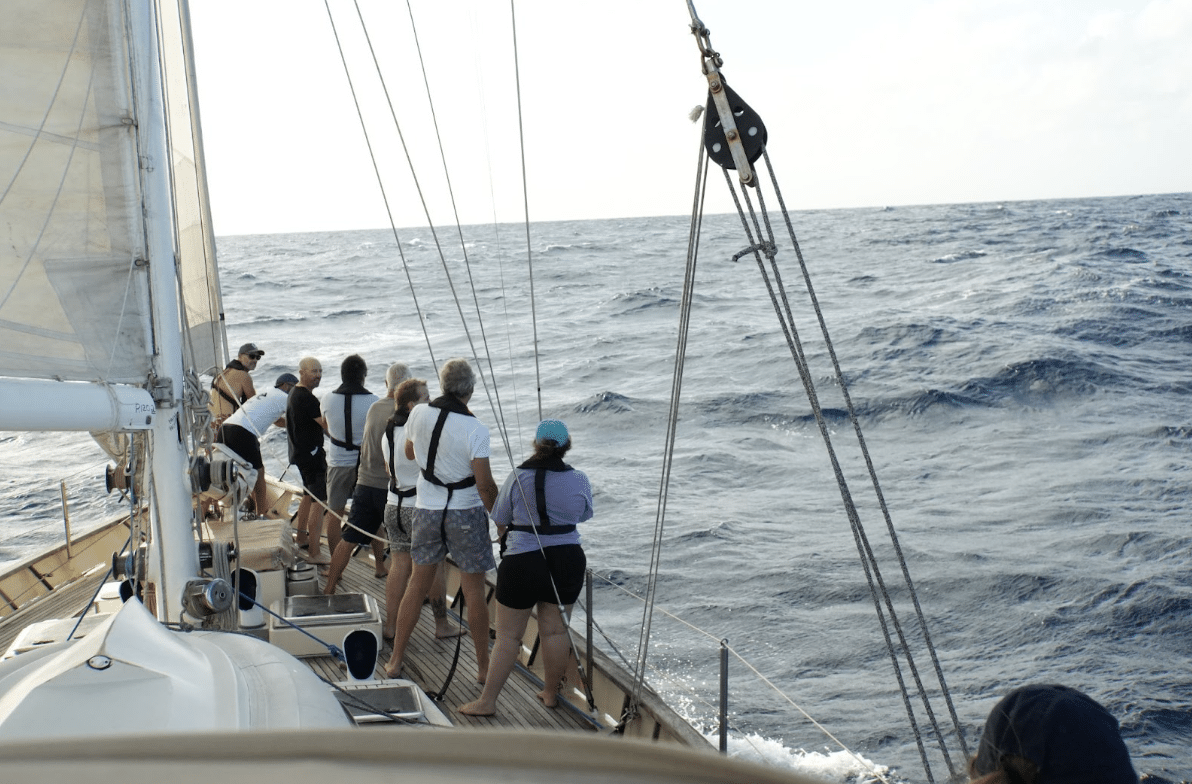
During that time each person can participate in the navigation: help with the sails, take the helm for a while or simply observe how the color of the water changes as new islands are approached. At the end of the day comes one of the most special moments of the voyage: finding a good anchorage, taking a sunset swim or going ashore to explore a beach or a small harbor. As the days go by, time starts to be measured differently. Not by timetables, but by the wind, the miles sailed or the distance to the next island.
How many miles are sailed on aCaribbean sailing trip usually covers considerable distances. Depending on the itinerary, it is usual to sail between 400 and more than 500 nautical miles during a week.. This makes it possible to combine longer sailing legs with shorter ones between different islands.
The Caribbean is especially interesting for this type of travel because many islands are relatively close to each other, allowing you to move forward every day and discover new places without having to cross large open oceans. In addition, the trade winds offer very stable sailing conditions for a good part of the year.
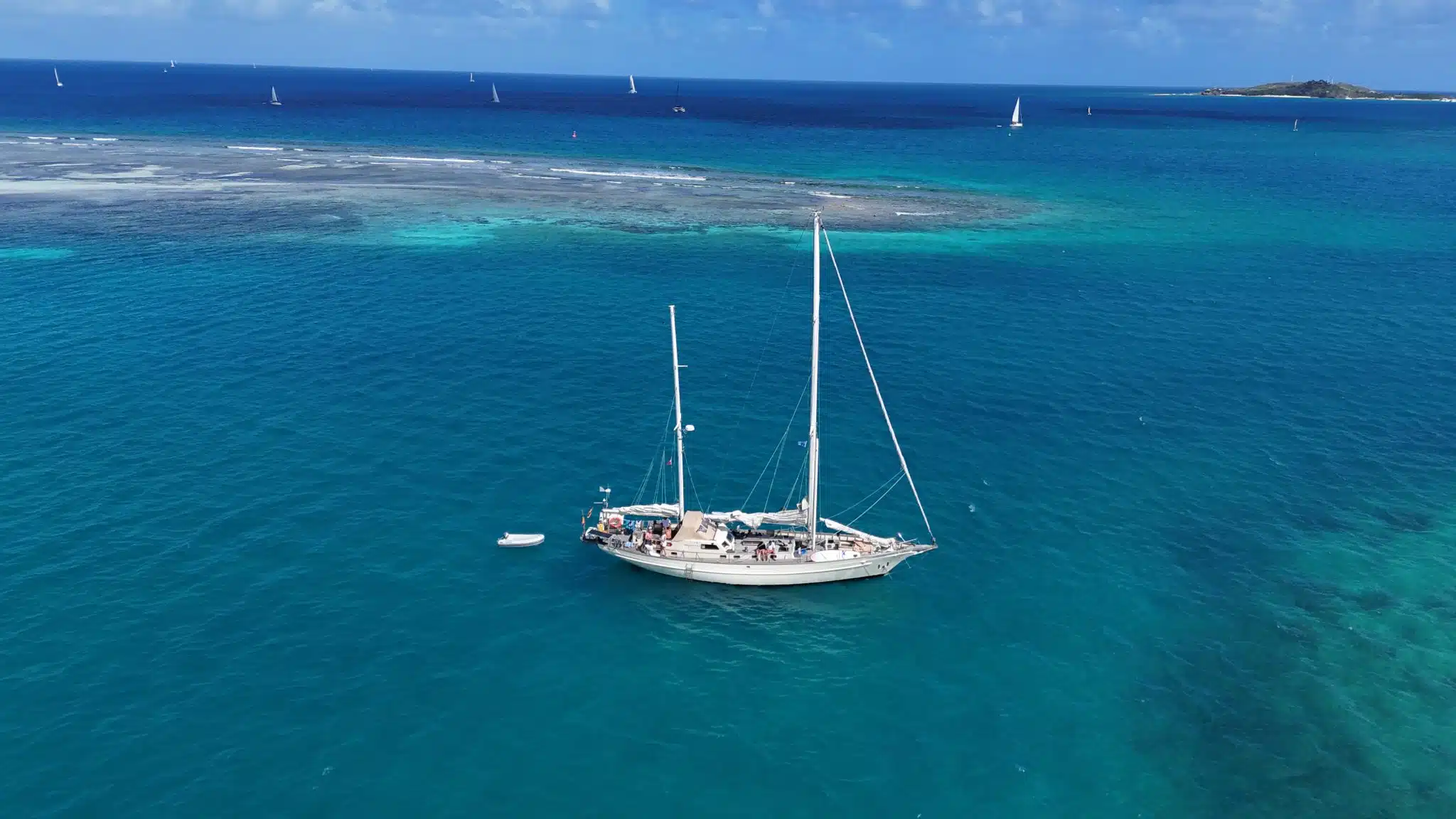
Sailboat: La Peregrina
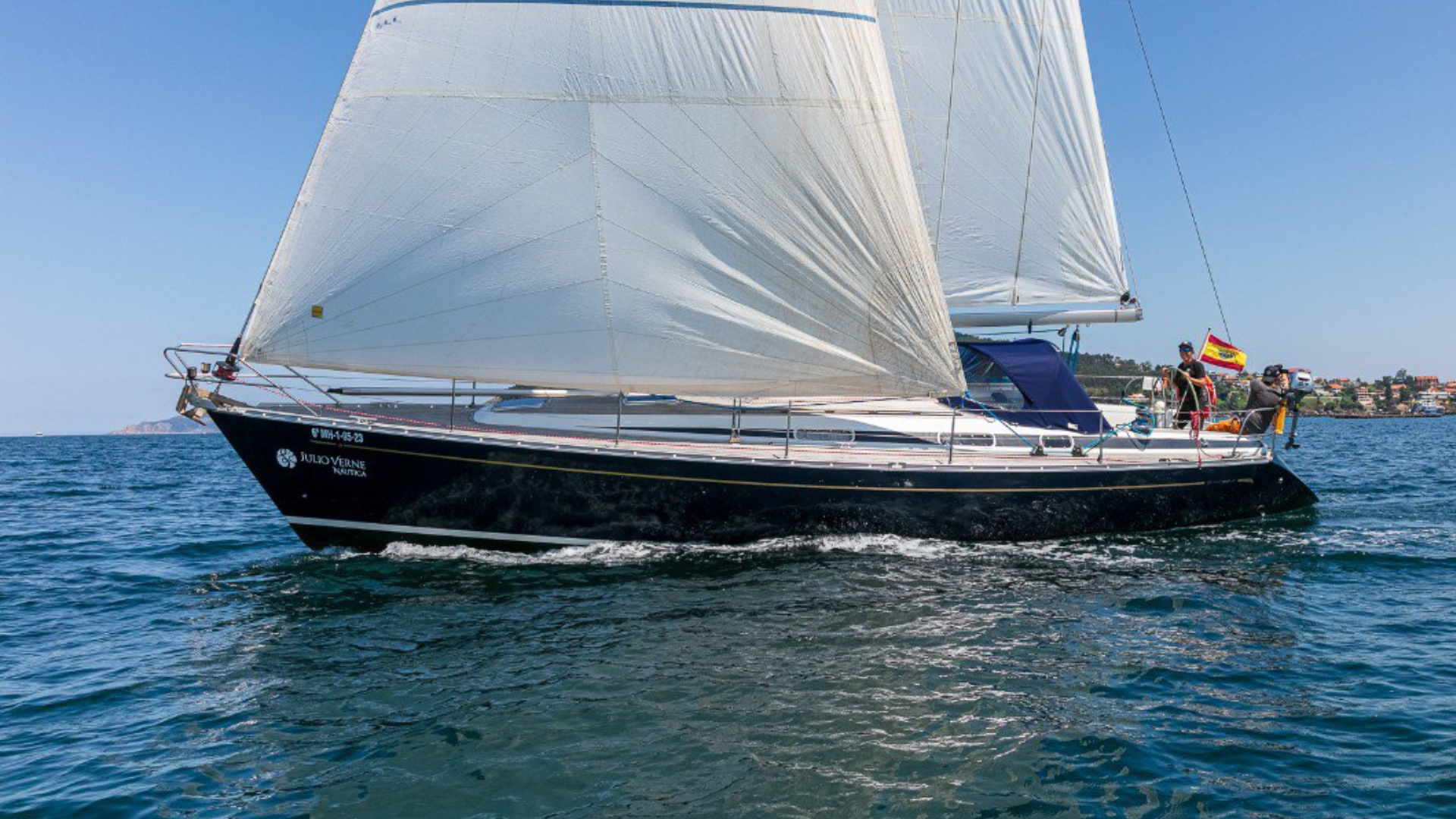
The voyages organized by Julio Verne Náutica take place aboard the following vessels La PeregrinaLa Peregrina, a 70-foot ocean-going sailing yacht designed by the prestigious naval architect German Frers. It is a steel ketch prepared to sail long distances in safety and comfort.
The boat has:
Five cabins
Several indoor common areas
Ample outdoor spaces to enjoy sailing
The Peregrina has crossed the Atlantic on numerous occasions and has been specifically prepared for crossings and sailing training. On board are two certified instructors who are in charge of safety and coordinating life on board during the entire experience.
What experience do you need to participate
One of the most common doubts is whether previous experience is necessary to participate in a crossing. The answer is that it is not essential to have sailed before.. Many people join this type of experience precisely to learn how sailing on a tall ship works. Those who already have nautical experience also find in these voyages a good opportunity to add miles and sail in a spectacular environment. The most important thing is to have curiosity for the sea, a desire to learn and a spirit of conviviality on board.
The Caribbean as seen from the sea
Getting to know the Caribbean from a sailboat completely changes the perspective of the trip. The islands appear on the horizon little by little, the rhythm of the day depends on the wind and each day ends in a different place. There are days of calm navigation between islands and others in which the sea becomes the real protagonist of the trip. For many people, that mix of adventure, learning and scenery is what makes a sailing trip an experience that is difficult to compare with any other type of voyage.
Frequently asked questions about sailboat cruises
Do you need to know how to sail?
No. Many people participate in crossings without previous experience. The boat’s crew is in charge of the navigation and those who want to can learn and participate in different maneuvers.
How many days does a sailing trip last?
Crossings usually last about a week, although some routes may be longer depending on the itinerary.
How many people are on board?
Normally small groups of crew members travel together with the skipper and the boat’s crew, which allows for a close and participative atmosphere.
Do you always fall asleep while sailing?
Not necessarily. Many nights are spent at anchor off an island or in port, depending on the route and sea conditions.
Getting to know the Caribbean by sailing
A sailing trip is a different way to discover the Caribbean. Instead of just visiting one destination, the trip consists of sailing among them, learning how life at sea works and discovering islands from a completely different perspective.
Sailing the Caribbean this way is not for everyone. Precisely for this reason, when it fits, it is remembered forever! People who have already experienced the adventure often call you: the experience of a lifetime. Are you interested?tell us about it!
Iván Pérez-Gándaras is CEO of Julio Verne Náutica and the main Director of the company's RYA Training Center. His vast experience is based on the highest nautical qualifications such as Yachtmaster without limits, STCW95 and RYA Yachtmaster Offshore with commercial endorsement. He has accumulated more than 20,000 ocean miles in deliveries and transatlantic crossings, in addition to 30,000 miles in scientific expeditions, including Antarctica and Newfoundland.
A trainer since 1993 and instructor of nautical qualifications since 2009, his background combines a solid technical background with exceptional practical experience. With a degree in Marine Biology from the University of Santiago de Compostela and World Champion in Dinghy Sailing (1989), his unique perspective ensures that Julio Verne Náutica's articles, training and charter services are delivered with the highest level of technical rigor and passion for the sea.
Grazas a esta axuda renováronse dous equipamentos electrónicos a bordo da “Peregrina” por novas opcións máis sostibles, sustituindo o equipamento de radar e de piloto automático. Equipamento de radar: A antena de radar FURUNO 1832 substitúiuse pola antena de radar RAYMARINE QUANTUM.
Co Q24D DOPPLER acadouse unha mellora enerxética. Esta mellora conséguiuse mediante a evolución da tecnoloxía de radar, obtendo un consumo moito menor; así como un software evolucionado e mellorado para unha navegación máis precisa, mellorando significativamente a seguridade a bordo.
Equipamento de piloto automático: O equipamento de piloto automático SIMRAD AC12 e a pantalla ZEUS TOUCH de 7″ foron substituídos por unha pantalla B&G NAC-3 + Triton2 e un controlador de piloto Triton2.
Descripción de la acción
Gracias a la ayuda de IGAPE, empresarios de los países Alemania y Francia, visitaron las instalaciones de Julio Verne Náutica y visitaron los distintos puntos turísticos clave de nuestras costas.
También pudimos publicitarnos en la revista Blauwasser de difusión en Alemania y Francia.
Por último, diseñamos y editamos los catálogos de la empresa que se distribuyeron a través de los visitantes que participaron en las misiones inversas y en las visitas a eventos internacionales en los que participa Julio Verne Náutica.
El proyecto Julio Verne Náutica se llevó a cabo gracias a una subvención de 25.814,80 euros concedida por la FEMP, la Conselleria do Mar y el GALP RIA DE VIGO-A GUARDA dentro del proyecto GALP-172, cuyos principales objetivos son promover el crecimiento económico a través de: la educación, el chárter, las rutas guiadas y el transporte en barco.
O proxecto Julio Verne Náutica se levou a cabo tras a subvención de 160.595,20€ aportados dende o FEMP, Conselleria do Mar e GALP RIA DE VIGO-A GUARDA a través do proxecto GALP7-092 cuxos principais obxectivos son o fomento do crecemento económico a través de: Formación, chárter, rutas guiadas e transporte de embarcacións.
Julio Verne Náutica conta co apoio do Inega (Instituto Enerxético de Galicia) para a mellora enerxética dirixida ao sector servizos a través do Programa “Bono enerxía peme 2023”, recibindo 4.788,00 € para este proxecto. Operación cofinanciada pola Xunta de Galicia. Conseguir unha economía mais limpa e sostible.
Julio Verne Náutica desarrolló el proyecto “Velas por el Alzheimer”, una iniciativa para acercar el mar, la navegación y la cultura marinera a personas con Alzheimer, familiares y cuidadores/as.
El programa incluyó talleres adaptados, visitas, salidas al entorno marítimo y una regata final inclusiva en la Ría de Vigo, con el objetivo de favorecer la participación social, el bienestar y la colaboración entre entidades sociales y náuticas.
El proyecto contó con el apoyo de la Xunta de Galicia, a través del IGAPE, en el marco de las ayudas para avanzar en criterios ambientales, sociales y de gobernanza —ASG— en empresas gallegas.





Comments are closed for this article!