The aspiring skipper’s big dilemma: Paper or calluses on his hands? It’s the million-dollar question at every sailing school and on every internet forum: “What comes first: hitting the books
Learn how to identify the right advanced course for you One of the questions we hear most often at the Baiona pier is, “Am I skilled enough to take this
Let’s be honest: learning to sail shouldn’t be a grueling ordeal of hitting the books, memorizing lights on boats you’ll never see in your life, and passing a multiple-choice test—only to end up staring at the helm with a panicked look on your face. All that stuff about the PER, the PNB, or the Yacht Skipper’s License is all well and good for complying with the Official State Gazette, but real sailing—the real deal—begins when you cast off and realize that the sea hasn’t read your exam manual.
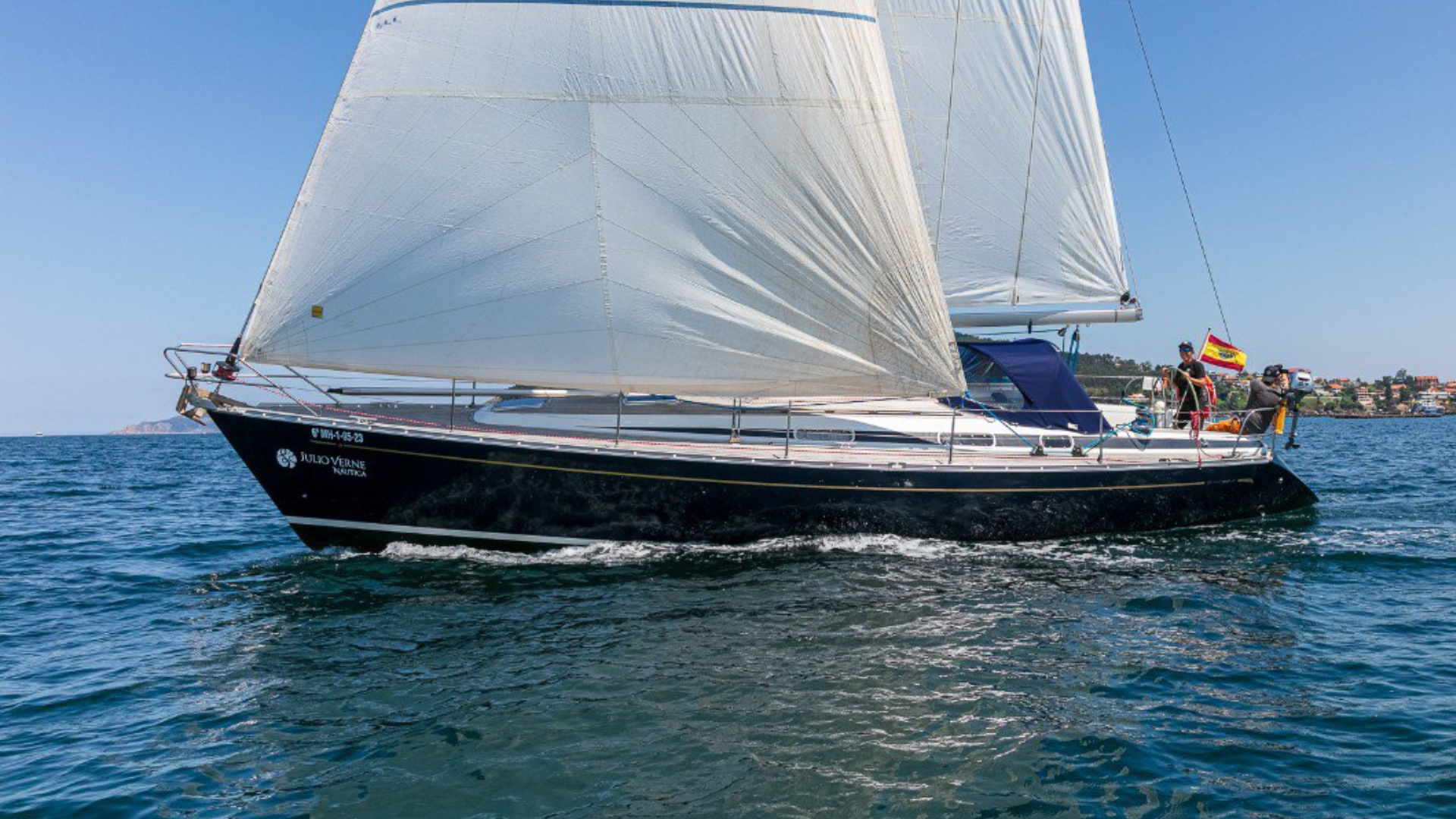
In Julio Verne Náutica , we approach training with a philosophy that should be the law: you learn to sail by sailing. Not in an air-conditioned classroom, nor by watching YouTube videos on the couch. Our courses in Baiona are designed for people who want to gain real confidence—the kind that lets you sleep soundly while at anchor or enter a harbor without your knees shaking. It doesn’t matter if you’re a complete beginner or if you already have your certification but lack that “punch” at the helm.
Sailing Courses in the Rías Baixas: Do you need a license? (Spoiler: NO)
One of the questions we get most often on WhatsApp is: “Hey, can I sign up if I don’t have the PER?”. The short answer is YES, and the long answer is that, in fact, sometimes it’s even better.
At Julio Verne Náutica, you can take almost all of our training courses without having a single official document. The Crew Member Course, the Monohull Course, and the Catamaran , and the specialized course on Mooring do not require a license. Why? Because learning how to use a rope, trim a mainsail, or avoid bumping into the dock are physical and mental skills, not administrative ones.
The only exception is ourWinter Training, where we do require the PER because there we’re aiming for total independence: we want you to be the responsible skipper while we watch from the sidelines. But for everything else, the ideal is to learn to sail before getting your license. Why? Because when you get to the theory part, you’ll already know what they’re talking about. You’ll have judgment, context, and, above all, you’ll have felt the wind on your face before calculating a course on the chart.
What Does It Mean to Really Know How to Sail? (The Question That Terrifies Armchair Experts)
That’s the million-dollar question. Knowing how to sail isn’t just about holding the helm while the autopilot does the dirty work. Nor is it about having a yacht captain’s license if you don’t know what to do when the engine sputters.
Knowing how to sail means having good judgment. It means understanding how your hull responds to the current, knowing how to prepare to drop anchor before the sun goes down, figuring out if that dark cloud is going to ruin your afternoon, and communicating with your crew without shouting or drama. It also means knowing when do nothing. On board, acting on impulse or without good judgment usually ends in a breakdown or a scare. The art of sailing isn’t about pressing a lot of buttons, but about understanding what the boat needs at every moment.
The confidence on board is a muscle that’s built through repetition, corrected mistakes, and many miles under the keel. It doesn’t come from having a laminated certificate; it comes when you feel like the boat and you speak the same language.
Personalized attention: Forget about those massive “weekend warrior” classes
Every sailor is unique. Some have an innate talent for trimming the sails but panic when docking. Others are experts at reading the weather but can’t execute a perfect tack under pressure. That’s why, at Julio Verne Náutica, we work with small groups.
Sailing instruction can’t be a field trip with 15 people crammed on deck where only one person gets to touch the wheel. That’s not learning—that’s just a ride. We believe in a hands-on approach: small groups where the instructor can see you, correct your helm angle, explain why that line isn’t working properly, and tailor the practice to your fears and your goals. We want you to come away a better sailor, not just to kill time.
A course for every “problem” a web surfer might face
Our training program in Baiona covers all areas, so you have no excuses:
Crew Training Course: If you’re starting from scratch, this is the place for you. Stop being the guest who’s only good for opening beers and become someone useful who knows how to handle ropes, understands orders, and moves around the deck with confidence.
Monohull Course: For those who want to perfect their skills on the sailboat they’ve always sailed. Steering, fine-tuning the sails, and maneuvers under sail and motor. This is where you go from being just a “certified sailor” to becoming a true sailor.
Catamaran Course: Forget everything you know about monohulls. Here you’ve got two engines, a much wider beam, and inertia that you’ll need to learn how to manage. If you’re planning to rent a Lagoon or a Fountain Pajot this summer, don’t take any chances without stopping by here first.
Docking Course: The specialized course for those who have nightmares about the dock. Technique, calm, and repetition. You’ll practice docking and undocking until you can do it with a coffee in hand.
Winter Training: The ultimate “level up.” Self-sufficiency training for skippers who want to start sailing solo but with the support of professional guidance.
Baiona and the Rías Baixas: Your Elite Training Ground
The setting matters. Our base at the Monte Real Yacht Club in Baiona is strategically located. We have sheltered waters for stress-free sailing, yet the Atlantic is just a stone’s throw away.
The Rías Baixas allow for year-round sailing (winter is when true skippers are made) with varied conditions, incredible anchorage spots in the Cíes Islands, and a network of nearby harbors where you can practice docking until you’re bored. Baiona isn’t just where we’re located; it’s our teaching tool.
Bottom line: The sea is waiting for you—stop reading and come on out!
Get trained in Julio Verne Náutica means choosing the difficult but rewarding path: that of hands-on experience. We have our own boats (in impeccable condition, by the way), instructors who are seasoned sailors, and a teaching method that gets right to the point.
If you want to stop being a passenger in your own boating life and start truly taking the helm, choose your course and we’ll see you at the dock. Because in the end, the only difference between a skipper and a tourist is confidence. And that, my friend, can only be earned on the water.
Are you coming to surf, or are you going to wait for someone to tell you about it?
Iván Pérez-Gándaras is CEO of Julio Verne Náutica and the main Director of the company's RYA Training Center. His vast experience is based on the highest nautical qualifications such as Yachtmaster without limits, STCW95 and RYA Yachtmaster Offshore with commercial endorsement. He has accumulated more than 20,000 ocean miles in deliveries and transatlantic crossings, in addition to 30,000 miles in scientific expeditions, including Antarctica and Newfoundland.
A trainer since 1993 and instructor of nautical qualifications since 2009, his background combines a solid technical background with exceptional practical experience. With a degree in Marine Biology from the University of Santiago de Compostela and World Champion in Dinghy Sailing (1989), his unique perspective ensures that Julio Verne Náutica's articles, training and charter services are delivered with the highest level of technical rigor and passion for the sea.
Grazas a esta axuda renováronse dous equipamentos electrónicos a bordo da “Peregrina” por novas opcións máis sostibles, sustituindo o equipamento de radar e de piloto automático. Equipamento de radar: A antena de radar FURUNO 1832 substitúiuse pola antena de radar RAYMARINE QUANTUM.
Co Q24D DOPPLER acadouse unha mellora enerxética. Esta mellora conséguiuse mediante a evolución da tecnoloxía de radar, obtendo un consumo moito menor; así como un software evolucionado e mellorado para unha navegación máis precisa, mellorando significativamente a seguridade a bordo.
Equipamento de piloto automático: O equipamento de piloto automático SIMRAD AC12 e a pantalla ZEUS TOUCH de 7″ foron substituídos por unha pantalla B&G NAC-3 + Triton2 e un controlador de piloto Triton2.
Descripción de la acción
Gracias a la ayuda de IGAPE, empresarios de los países Alemania y Francia, visitaron las instalaciones de Julio Verne Náutica y visitaron los distintos puntos turísticos clave de nuestras costas.
También pudimos publicitarnos en la revista Blauwasser de difusión en Alemania y Francia.
Por último, diseñamos y editamos los catálogos de la empresa que se distribuyeron a través de los visitantes que participaron en las misiones inversas y en las visitas a eventos internacionales en los que participa Julio Verne Náutica.
El proyecto Julio Verne Náutica se llevó a cabo gracias a una subvención de 25.814,80 euros concedida por la FEMP, la Conselleria do Mar y el GALP RIA DE VIGO-A GUARDA dentro del proyecto GALP-172, cuyos principales objetivos son promover el crecimiento económico a través de: la educación, el chárter, las rutas guiadas y el transporte en barco.
O proxecto Julio Verne Náutica se levou a cabo tras a subvención de 160.595,20€ aportados dende o FEMP, Conselleria do Mar e GALP RIA DE VIGO-A GUARDA a través do proxecto GALP7-092 cuxos principais obxectivos son o fomento do crecemento económico a través de: Formación, chárter, rutas guiadas e transporte de embarcacións.
Julio Verne Náutica conta co apoio do Inega (Instituto Enerxético de Galicia) para a mellora enerxética dirixida ao sector servizos a través do Programa “Bono enerxía peme 2023”, recibindo 4.788,00 € para este proxecto. Operación cofinanciada pola Xunta de Galicia. Conseguir unha economía mais limpa e sostible.
Julio Verne Náutica desarrolló el proyecto “Velas por el Alzheimer”, una iniciativa para acercar el mar, la navegación y la cultura marinera a personas con Alzheimer, familiares y cuidadores/as.
El programa incluyó talleres adaptados, visitas, salidas al entorno marítimo y una regata final inclusiva en la Ría de Vigo, con el objetivo de favorecer la participación social, el bienestar y la colaboración entre entidades sociales y náuticas.
El proyecto contó con el apoyo de la Xunta de Galicia, a través del IGAPE, en el marco de las ayudas para avanzar en criterios ambientales, sociales y de gobernanza —ASG— en empresas gallegas.




Comments are closed for this article!